Summation of infinitely divisible random variates
Our group, along with a few students, has been reading statistics handbook and refreshing our understanding of the basic statistics. Some time ago, I was given to cover a chapter about the central limit theorem, which reminded me that I had already given a similar presentation while being PhD student myself. While diving into the topic, I have noticed a couple things, which are usually glanced over in a typical statistics handbook. Let me share them with you.
This time we explore infinite divisibility. Our previous mathematical explorations of the stable distributions topic have relied on this property, because it simplifies many of the analytical derivations. But there are distributions, which are infinitely divisible but not stable. This time let us take a look at sums of Gamma distributed random variates.
Characteristic function of gamma distribution is given by,
\begin{equation} \varphi_\Gamma \left(t\right) = \left(1 - \theta t \mathrm{i} \right)^{-\alpha} . \end{equation}
Identical parameter values
One conclusion can be made simply by observation. If we add \( N \) independent random variates sampled from Gamma distribution with identical shape \( \alpha \) and scale \( \theta \) parameter values, the sum will be distributed according to the Gamma distribution with shape parameter equal to \( \alpha N \) and scale parameter equal to \( \theta \), as characteristic function of the sum would be given by,
\begin{equation} \varphi_\Sigma \left(t\right) = \varphi_\Gamma\left(t\right)^N = \left(1 - \theta t \mathrm{i} \right)^{-\alpha N} . \end{equation}
You can verify this result by using the interactive app below.
Note that this app is identical to the one we have used to test the summation of Cauchy-distributed random variates.
Different shape, identical scale
If the shape parameter values are predefined, but different for every random variate to be summed (while scale parameter values remain identical), i.e., if \( x_j \sim \mathrm{Gamma}\left(\alpha_j, \theta \right)\), then we have that:
\begin{equation} \varphi_\Sigma \left(t\right) = \varphi_{\Gamma(\alpha_1,\theta)}\left(t\right) \cdot \varphi_{\Gamma(\alpha_2,\theta)}\left(t\right) \cdot \ldots \cdot \varphi_{\Gamma(\alpha_N,\theta)}\left(t\right) = \left(1 - \theta t \mathrm{i} \right)^{-\sum_{j=1}^N\alpha_j} . \end{equation}
Once again, things look nice and this can be easily verified by using the interactive app below.
Different scale, identical shape
If the scale parameter values are predefined, but different for every random variate to be summed (while shape parameter values remain identical), i.e., if \( x_j \sim \mathrm{Gamma}\left(\alpha, \theta_j \right)\), then we have that:
\begin{equation} \varphi_\Sigma \left(t\right) = \varphi_{\Gamma(\alpha,\theta_1)}\left(t\right) \cdot \varphi_{\Gamma(\alpha,\theta_2)}\left(t\right) \cdot \ldots \cdot \varphi_{\Gamma(\alpha,\theta_N)}\left(t\right) = \left(1 - \theta_1 t \mathrm{i} \right)^{-\alpha} \cdot \left(1 - \theta_2 t \mathrm{i} \right)^{-\alpha} \cdot \ldots \cdot \left(1 - \theta_N t \mathrm{i} \right)^{-\alpha} . \end{equation}
This result can't be rewritten in a compact form. It also can't be reduced to a familiar form equivalent to the characteristic function of gamma distribution. Thus in this particular case the sum will not be be distributed according to the gamma distribution.
Though, as you can see in the app below, it is hard to actually verify by the eye. The only thing which betrays that something is wrong is that naive best parameter fits (theoretical \( \alpha \) and \( \theta \) values) have long fractional part (though the app shows just 2 numbers after the decimal point).
If you want to see that something is wrong, choose small \( \alpha \) and extremely different \( \theta_j \). This will make skewness (the third order moment) inconsistent with assumption that the sum is gamma-distributed, and some difference will become noticeable even by the eye.
Infinite divisibility
I guess, the overall point of this post is to admit that we have talked about the central limit theorem (and normal distribution by extension) and stable distributions (Cauchy distribution to be more specific) by making no distinction between what they actually are and the infinitely divisible distributions. As we have seen in this post, the class of infinitely divisible distributions is broader. Gamma distribution is infinitely divisible, but it is not stable.
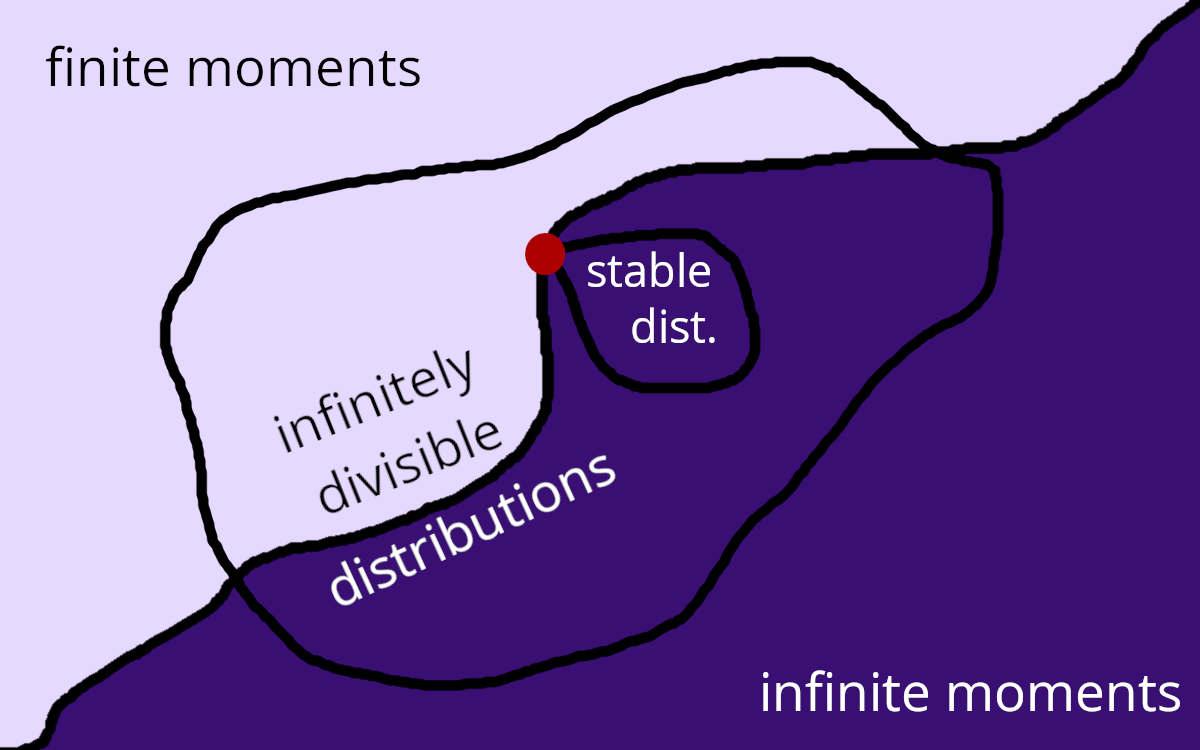 Fig. 1:Different classes of distributions and processes. Central limit theorem applies for all distributions with finite moments, and states that a sum of large number of such variates converges to the normal distribution, which is represented by a red dot in this figure. Normal distribution has finite moments, is infinitely divisible and stable.
In my opinion, this point is best illustrated by Figure 4.3 from [1], which I have tried to replicate in the figure above. It shows that there are distributions (and their generating process), which have finite and infinite moments. Some of these distributions are infinitely divisible, while others are not. Infinitely divisible distributions may have finite or infinite moments. Some of the infinitely divisible distributions are also stable, while some others (such gamma distribution) are not. Most stable distributions have infinite (or undefined) moments, normal distribution is the only stable distribution which has finite moments (the red dot in our figure).
References
- R. N. Mantegna, H. E. Stanley. Introduction to Econophysics: Correlations and Complexity in Finance. Cambridge University Press, 1999. doi: 10.1017/CBO9780511755767.